
For somebody who’s been a fan of The Legend of Zelda: Ocarina of Time for nearly 30 years, like me, Tuesday’s reveal of Nintendo’s new Change 2 remake had a few heart-stopping moments.
The primary of those was our first glimpse of the sport, with younger Hyperlink standing in Kokiri Forest. Like a whole lot of viewers, I had blended emotions. The element of the scene was stunning, overwhelming, all the way down to Hyperlink’s distractingly textured hat, and components of the presentation appeared to tip over into the uncanny valley — notably Hyperlink himself. Had Nintendo, after holding out for 20 years, lastly succumbed to the high-definition mania that tempts so many studios to fill all that decision with useless noise?
Because the footage unspooled, I used to be reassured that Nintendo was staying firmly trustworthy to the gameplay of the unique masterpiece, with a couple of wise modernizations like a soar button and free digicam motion. However I did not have a agency grasp of the artwork fashion, and I wasn’t 100% certain that Nintendo did both.
Then Zelda producer Eiji Aonuma guided Hyperlink out onto Hyrule Area, and my coronary heart stopped a second time.
A bit of historic context: In 1998, strolling onto Hyrule Area within the unique Ocarina of Time was a seminal second. After the tight confines of Kokiri Forest, the Deku Tree, and the Misplaced Woods, it was a breathtakingly open house by the requirements of the time. The landmarks dotted round its large vista gave a way (nonetheless false) of a single, interconnected world that few early 3D video games had managed to evoke. Along with the stirring musical theme, it created a strong sense of journey.
However, by the requirements of recent open-world video games — The Legend of Zelda: Breath of the Wild not least amongst them — Hyrule Area is completely tiny. Earlier than the reveal, I used to be apprehensive about how Nintendo would adapt it. Taking an open-world method to the remake would absolutely destroy Ocarina’s immaculate construction and fairytale appeal. But when Nintendo remained trustworthy to the unique house, how might the magic of Hyrule Area be preserved for contemporary gamers, who’ve vastly expanded expectations of online game environments?
I needn’t have apprehensive; Nintendo has nailed it.
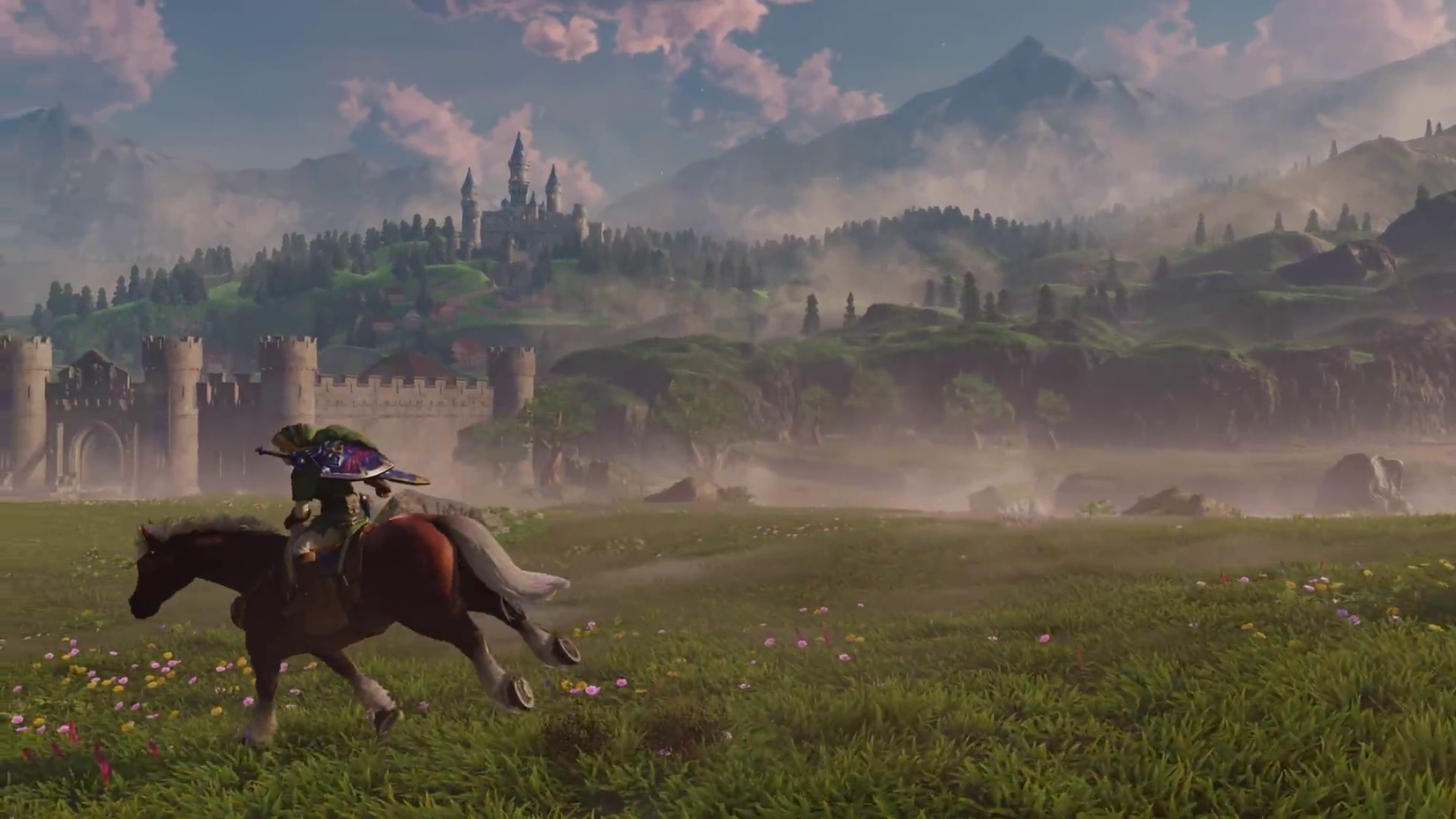
Picture: Nintendo
The Ocarina of Time remake surrounds Hyrule Area’s rolling grasslands with an astonishingly lovely diorama exhibiting the remainder of the dominion. Dying Mountain looms at a powerful, smoky scale. Hyrule Citadel’s spires are wreathed in mist on a forested hilltop past the city gates. Kakariko Village’s windmill spins lazily within the background. The ochre rock spires of Gerudo Valley trace at radically totally different landscapes past.
The impact sits someplace between a plausible, sensible 3D house and a sense such as you’re inhabiting an airbrushed storybook cowl or a matte portray backdrop from an outdated Technicolor film. You may inform that it is not a real open world — that it is an phantasm created with layers of geometry, painted artwork property, and lighting results. The vista is simply too dense, too impossibly romantically lit, to really feel actual. However that is intentional.
That is after I lastly understood what Nintendo’s artists are going for with Ocarina of Time on Change 2. In remaking an outdated recreation with trendy visuals, they’ve chosen an method that feels outdated in addition to new. As Aonuma put it within the demo: “We did not simply intention for sensible graphics. We had been notably centered on reimagining them in a method that feels nostalgic.” The sport’s look is intentionally unreal: busy, painterly, dreamlike, heightened. It is not presupposed to be solely convincing, or to really feel like a product of the right here and now.
This method fits the age of the sport design, which may solely be up to date thus far. It additionally fits the spirit of the sport; Ocarina of Time is not a simulated world like Breath of the Wild, it is a fairy story, a playable fable. And the method ensures that, by totally different means, Nintendo can nonetheless make you’re feeling a rush of surprise as you step out onto Hyrule Area for the primary time and anticipate the journey forward.

Associated
7 hidden particulars you may need missed within the Zelda: Ocarina of Time trailer
Owls, fairies, and extra blink-and-you’ll-miss-it teases


