
No, I am not joking. This new Asus G1000 gaming PC actually does have holograph ‘followers,’ a scoop-like cooling construction on its prime, and a super-thick aspect panel that mix to make this one of many largest pre-built gaming PCs I’ve ever seen.
Asus might hardly have picked a worse time to drop a super-luxury, outlandish gaming PC, what with graphics card and reminiscence costs going sky-high and the gaming business in one thing of a lull. Nevertheless, in the event you do fancy a critically swish improve this yr, you would possibly wish to maintain your eyes peeled for the discharge of this beast that’s certain to be among the finest gaming PCs round.
When it comes to specs, this PC is at the moment solely out there in a maxed-out configuration with an Asus Nvidia GeForce RTX 5090 graphics card, AMD Ryzen 9 9950X3D CPU, 32GB of DDR5 RAM, and 2TB of SSD storage. Nevertheless, what actually units it aside is the way it’s put collectively.
Ranging from the highest, that hood scoop is definitely the air flow for the 420mm AIO liquid cooler that cools the CPU. A gap within the left aspect of the case supplies the cool-air consumption, with the recent air from the radiator expelled straight out the highest of the case. This part is totally remoted from the remainder of the case, leaving all the opposite case followers solely needing to deal with the graphics card, motherboard, RAM, and SSD cooling.

That different cooling consists of a 140mm fan within the base of the case, the place it directs cool air straight to the pass-through cooler of the graphics playing cards. There are additionally followers within the entrance of the case and an exhaust fan on the again.
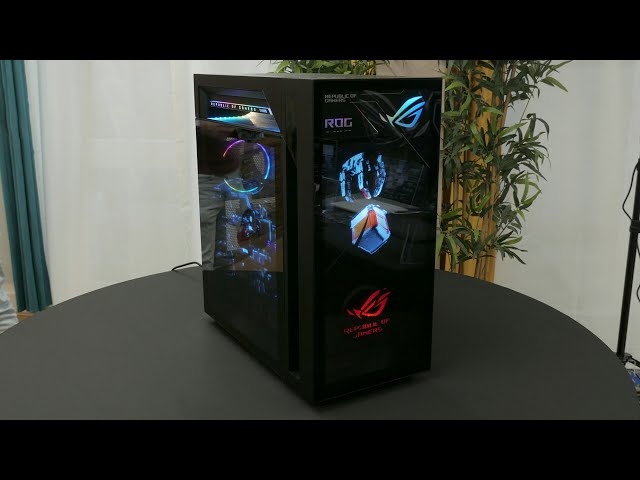
Air flow for these entrance followers is supplied by the full-length hole that runs down between the entrance panel of the case and the remainder of the PC behind. This false entrance panel is the place we then first see these whacky holographic ‘followers.’ Why the quotes? Nicely, as a result of they don’t seem to be followers that transfer air, however simply spinning gentle strips that may create a translucent holographic lighting impact.

680 LEDs are packed into every ‘fan,’ permitting them to show photos of half that resoltion. Two smaller ones are within the entrance, whereas a second bigger one fills your complete aspect panel. It is this aspect panel show that makes it so thick, with the lights and the motor that spins all of them needing to be housed within the hinged glass panel.

It is truthful to say this maximal model will not be to everybody’s style, nevertheless it actually makes an impression. This model remains to be only a prototype, with Asus nonetheless engaged on particulars comparable to extra neatly protecting the PSU space, so we have no mounted launch date or value but, however we actually cannot wait to see if this machine ever really makes it to market.


![[DEV] [SpellForce 2] Grasp of Battle – Forces of Eo (Model 4.6 – 10 years anniversary replace)](https://i0.wp.com/external-preview.redd.it/aaym82KWuD-GgiBwYv-YHpwv2y5I3XDhAiOAXrORAXA.jpeg?width=320&crop=smart&auto=webp&s=3b685a0681f0c17e95eb52bc36aab6215b31d646&w=120&resize=120,86&ssl=1)


![[DEV] Information Bubble – informal mind sport hub with 20+ mini video games (multiplayer + leaderboard) | open testing](https://i3.wp.com/preview.redd.it/epoyifdxt6vg1.png?width=640&crop=smart&auto=webp&s=52fd112031e4079bca724741ff8ee88689d65d1a&w=120&resize=120,86&ssl=1)
