
There are specific issues in life that, as soon as seen, cannot be unseen. The arrow within the FedEx emblem, as an example. Or the truth that my beard is quickly going gray, proving as soon as and for all that I’m actually a mortal man.
Effectively, I’ve had an opportunity to take a look at Nvidia’s new G-Sync Pulsar tech in motion at CES 2026, and now I am afraid that every one different gaming screens look a bit… crap. It is Medusa-like tech. I’ve seen it, I am unable to unsee it, and now I am perpetually modified.
Associated articles
Abruptly, it felt like my eyes have been not struggling to maintain up with the fast-moving picture. The image general, with each fast-moving and static objects, appeared to beam straight into my retinas with spectacular precision—leading to a shifting picture high quality that appears miles forward of something I’ve seen thus far.
I used to be additionally proven a demo of Anno 117: Pax Romana operating on the monitor tech, which initially struck me as an odd selection. In any case, metropolis builders aren’t precisely identified for his or her fast-paced motion. Nevertheless, shifting the digicam round immediately revealed why Nvidia picked it as an illustration piece. Tons of icons, overlaid on an in depth map, with plenty of zooming out and in of the sport space.
Once more, the readability distinction below movement was simple. One was onerous to parse below quick motion, the opposite, utterly legible, whether or not focussing on particulars or a shifting scene general.
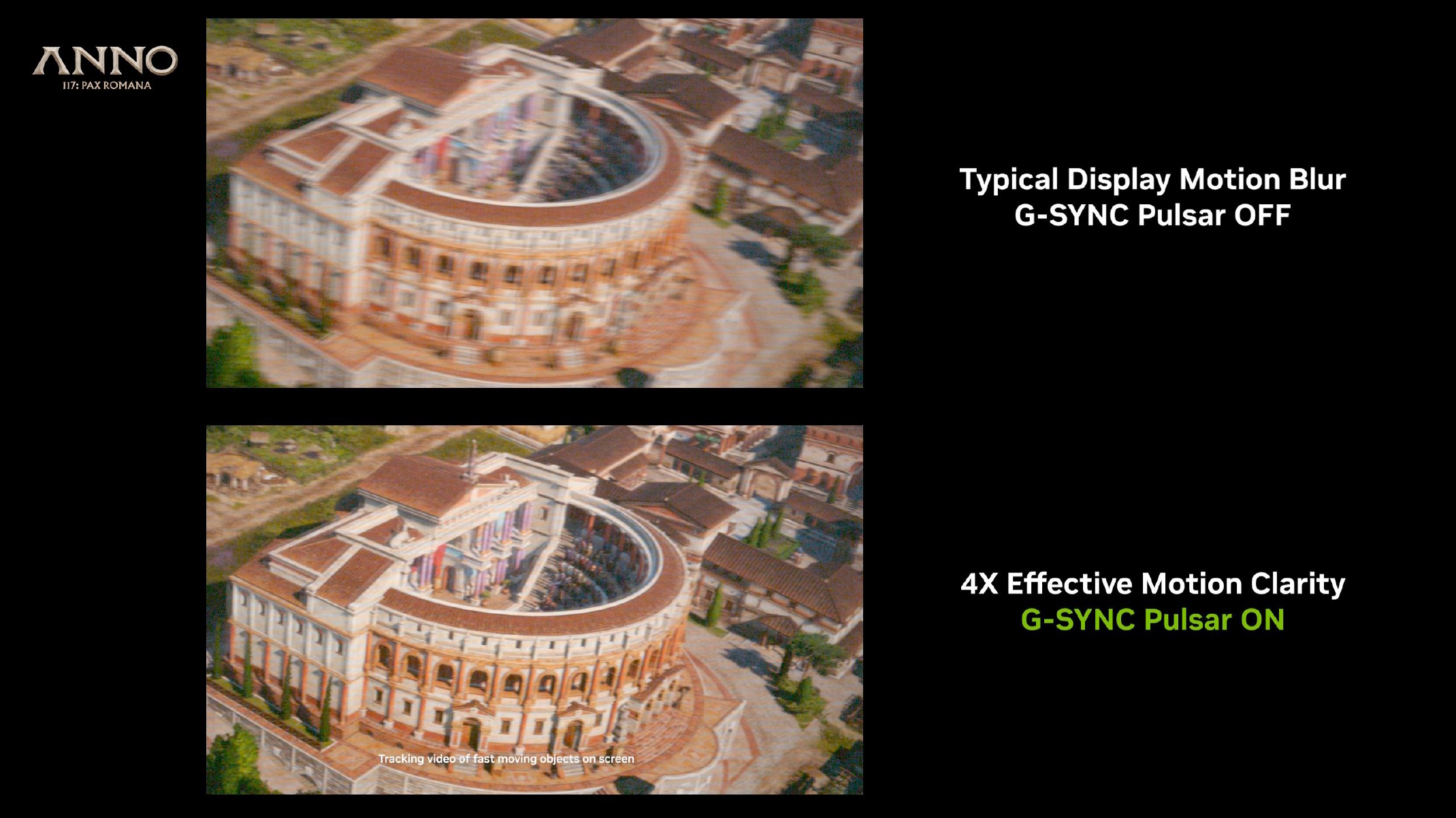
Now, you are going to should take my phrase for this (and a few less-than-useful nonetheless photos), as capturing the impact in particular person is a nigh-on not possible process. Digital camera sensors, conflicting body charges, video compression, all of it take its toll. Capturing new monitor tech advances on a median lens is akin to describing your favorite film by way of the medium of interpretive dance.
However let me let you know, as somebody who’s stood in entrance of a whole lot (possible hundreds, at this level) of extraordinarily good gaming screens, the best way G-Sync Pulsar adjustments the way you understand fast paced photos is downright profound.
Associated articles
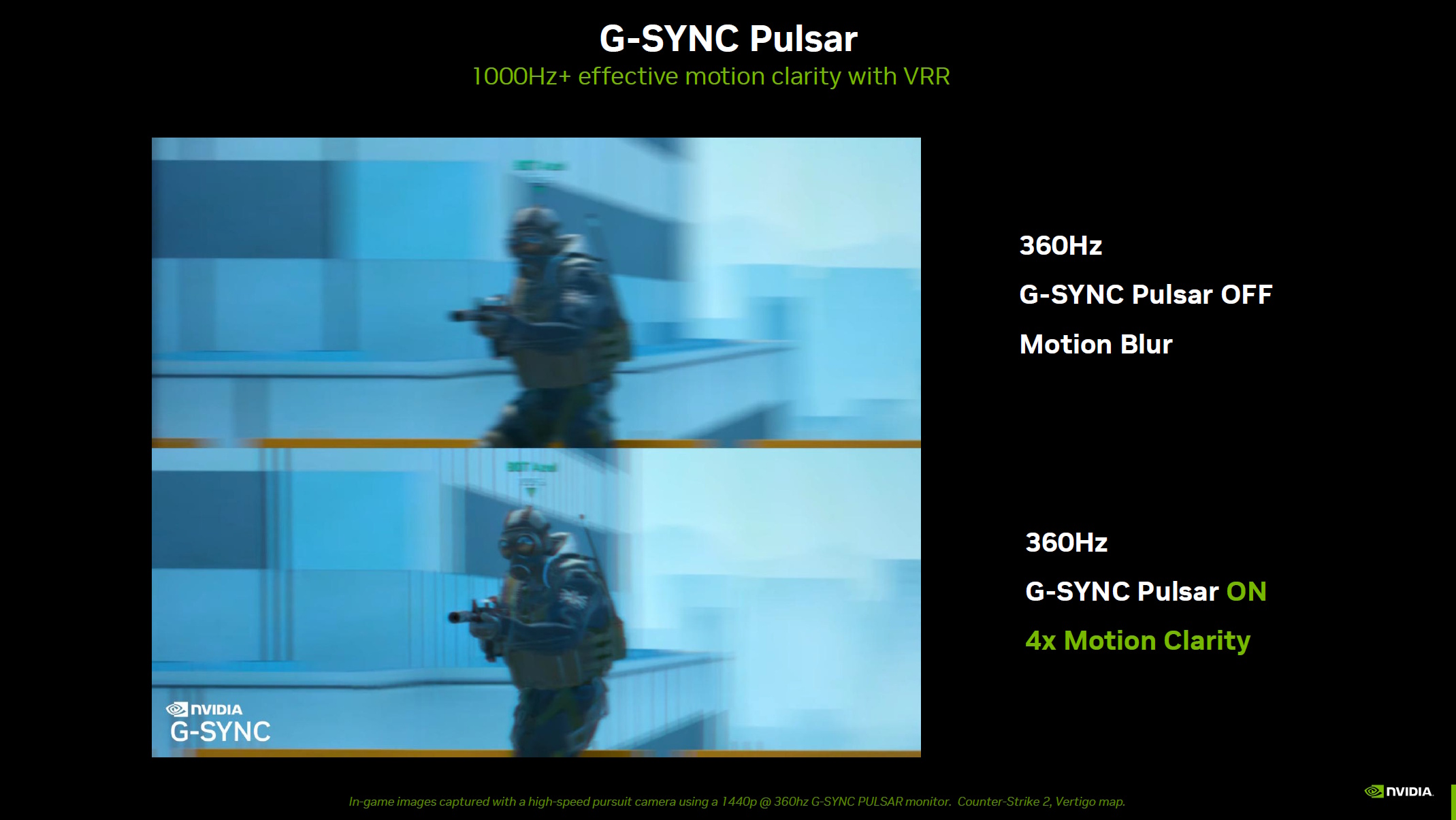
Chatting to Lars Weinand, considered one of Nvidia’s senior technical venture managers, concerning the tech revealed a bit extra about the way it works:
“There’s an issue known as movement maintain,” Weinand defined. “When the backlight is on, and the pixels are all the time seen, the display is drawn from high to backside for each body—that means that when there’s motion, the pixel is drawn, after which it stays in place for a complete body till it is overwritten by the subsequent one.
“In the best way our retina, our human system works, our mind interprets this as movement—after I transfer my finger like this (Weinand moved his finger shortly in entrance of his eyes at this level), it is blurred, proper? That is how our imaginative and prescient system works.”
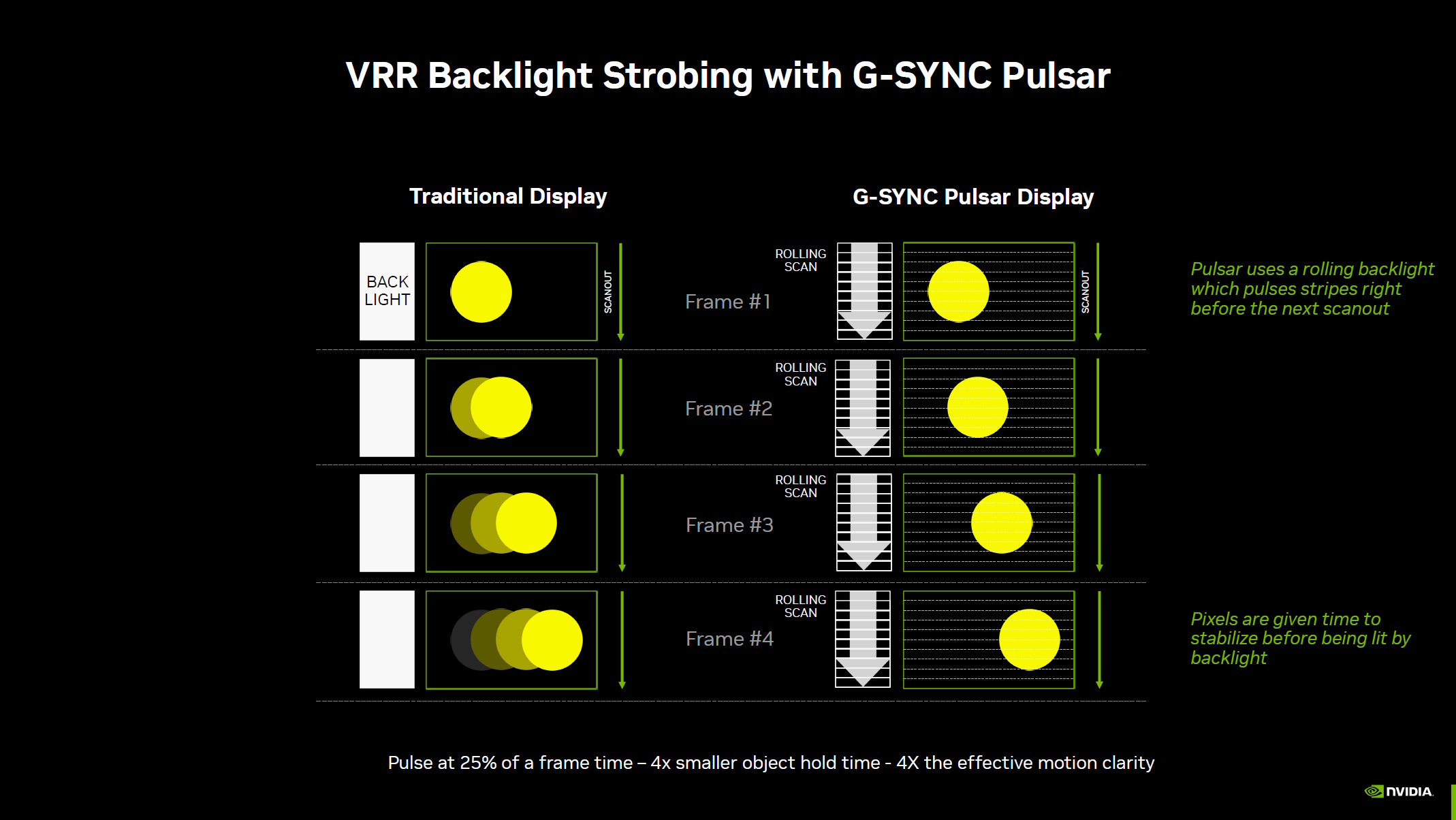
“So what we do to keep away from this, with an LCD, we flip off the backlight and solely present [the frame] as soon as it is settled in place. Within the earlier model, this all the time strobed the entire display directly. In order that was ULMB, however it by no means labored with VRR.
“What we’re doing now could be a rolling scan, so the scan out is going on from high to backside, and we strobe proper earlier than the scan out reaches the subsequent part [of the display]. This manner, we are able to make it variable, as a result of at a special refresh charge, if that adjustments, the stroke must go sooner.
…the tip result’s that you just get 4 occasions increased movement readability
Lars Weinand, Nvidia
“So the show is dealing with all that, adjusting to [refresh rate] frequencies, adjusting the strobe, and the tip result’s that you just get 4 occasions increased movement readability.”
Combining the strobing expertise with the silky smoothness of VRR actually does seem to have made a large distinction to the general impact. I noticed a earlier iteration of the tech many moons in the past when it was nonetheless below wraps, and I used to be impressed then. Now? It seems like a real sport changer.
CES 2026

Meet up with CES 2026: We’re on the bottom in sunny Las Vegas overlaying all the newest bulletins from a few of the greatest names in tech, together with Nvidia, AMD, Intel, Asus, Razer, MSI and extra.
There are downsides, after all. Not all panels are G-Sync Pulsar succesful, because it requires fast-responding IPS backlights that must be accredited by Nvidia as able to delivering the impact. Plus, it requires an onboard MediaTek scaler chip, and the tactic does not work with OLED shows, which gentle every pixel individually slightly than utilizing a backlight.
And whereas a wide range of G-Sync Pulsar shows might be accessible from January 6, the most affordable variant within the first batch is an AOC mannequin with what I am advised will possible be a $600+ price ticket—which is rather a lot to pay for a 27-inch 1440p IPS panel.
Nonetheless, having seen G-Sync Pulsar in motion, I am totally satisfied by the uplift in perceived movement high quality. The thorny query now could be, which might I slightly have—the unbelievable distinction and vivid colors of an excellent OLED gaming monitor, or a pin-sharp, extremely clear, fast-responding IPS for related money?
In all honesty, I would nonetheless plump for the OLED. However now I’ve seen G-Sync Pulsar in particular person, it is extra of a close-run factor than you may suppose.


